Decarbonisation Glossary
Find some useful definitions on decarb-related concepts below.




Abatement: Reducing or avoiding greenhouse gas emissions, or removing/sequestering these gases from the atmosphere.
Adaptation: Modifying and adjusting approaches to address actual or expected climate effects, such as building flood defence systems.
Carbon capture and storage (CCS): A process that traps, compresses and permanently stores carbon dioxide (CO2) from industrial or energy-related sources.
Carbon capture and use (CCU): A process that captures and uses generated CO2 in a product or industrial processes, delaying emissions.
Carbon credit: A unit/permit that represents one tonne of reduced or removed greenhouse gases. The United Nations allocates credits to countries for distribution to organisations and can be traded between companies.
Climate change: A change in the state of climate (e.g., sustained weather patterns) identified by statistical testing, due to natural internal processes, external forcings (e.g., volcanic eruptions), or alterations to atmospheric/land-use composition due to human activity.
Carbon footprint: The measure of the total CO2 emissions of an individual, entity or product that is generated, directly or indirectly, by human activities/over a product's lifespan.
Decarbonisation: The act of reducing and removing CO2 from the atmosphere. This involves both decreasing carbon dioxide outputs and removing existing atmospheric carbon. This can be achieved by transitioning away from high-carbon emitting activities, adopting low-carbon emitting alternatives and actively implementing carbon-sequestering initiatives.
- Why decarbonisation? As carbon dioxide is the main greenhouse gas emitted from human activities (anthropogenic emissions), it is the largest contributor to human-induced global warming. Therefore, decarbonisation plays a critical role in mitigating the impacts of human-induced global warming.
Firming: Ensuring reliable electrical supply by implementing other generation sources to support variable renewable electricity.
Fugitive emissions: Emissions that are released intentionally or unintentionally, typically through leaks or venting. These can include leaks from equipment (e.g., joints, seals and gaskets), methane from gas transport or coal mining, and hydrofluorocarbon (HFC) emissions from refrigeration/air-conditioning equipment use.
Greenhouse effect: A natural process which allows sunlight into Earth's atmosphere and results in trapped heat around the planet due to the absorption of thermal infrared radiation by gases. This process has been exacerbated by human activities.
Greenhouse gases (GHG): Gases that accumulate in earth’s atmosphere and trap heat, contributing to planetary warming (commonly known as the greenhouse effect). There are 7 widely recognised greenhouse gases that companies must consider in their emissions reporting and reduction targets. These are: carbon dioxide (CO2), methane (CH4), nitrous oxide (N2O) and fluorinated gases including hydrofluorocarbons (HFCs), perfluorocarbons (PFCs), sulphur hexafluoride (SF6), nitrogen trifluoride (NF3). GHG outputs can be categorised into 4 broad groups—or ‘scopes’—that provide information on which activities emissions are generated from.
- Scope 1 (Direct): Greenhouse gases that a company generates directly from their own activities/operations and assets e.g., emissions from company vehicles, machinery, fugitive emissions etc.
- Scope 2 (Indirect): Greenhouse gases that are generated off-site by third parties to support or facilitate the activities/operations of a company e.g. emissions from electricity generated by a utility company for workplace lighting, temperature regulation, kitchen appliances etc.
- Scope 3 (Indirect): Greenhouse gases that are generated in the production process and utilisation of a company’s assets or products, including extraction and distribution of raw materials and consumer use of goods produced. This category accounts for a company’s entire value chain and is commonly referred to as a company’s ‘upstream’ and ‘downstream’ emissions. e.g. extracting and transporting coal for electricity, emissions from the disposal of a company’s waste etc.
- Scope 4 (Avoided): Emissions avoided by opting for a lower-emissions alternative e.g., teleconferencing to reduce commuting emissions, fuel-efficient tyres, eco-friendly appliances, choosing reusable products over single-use ones etc.
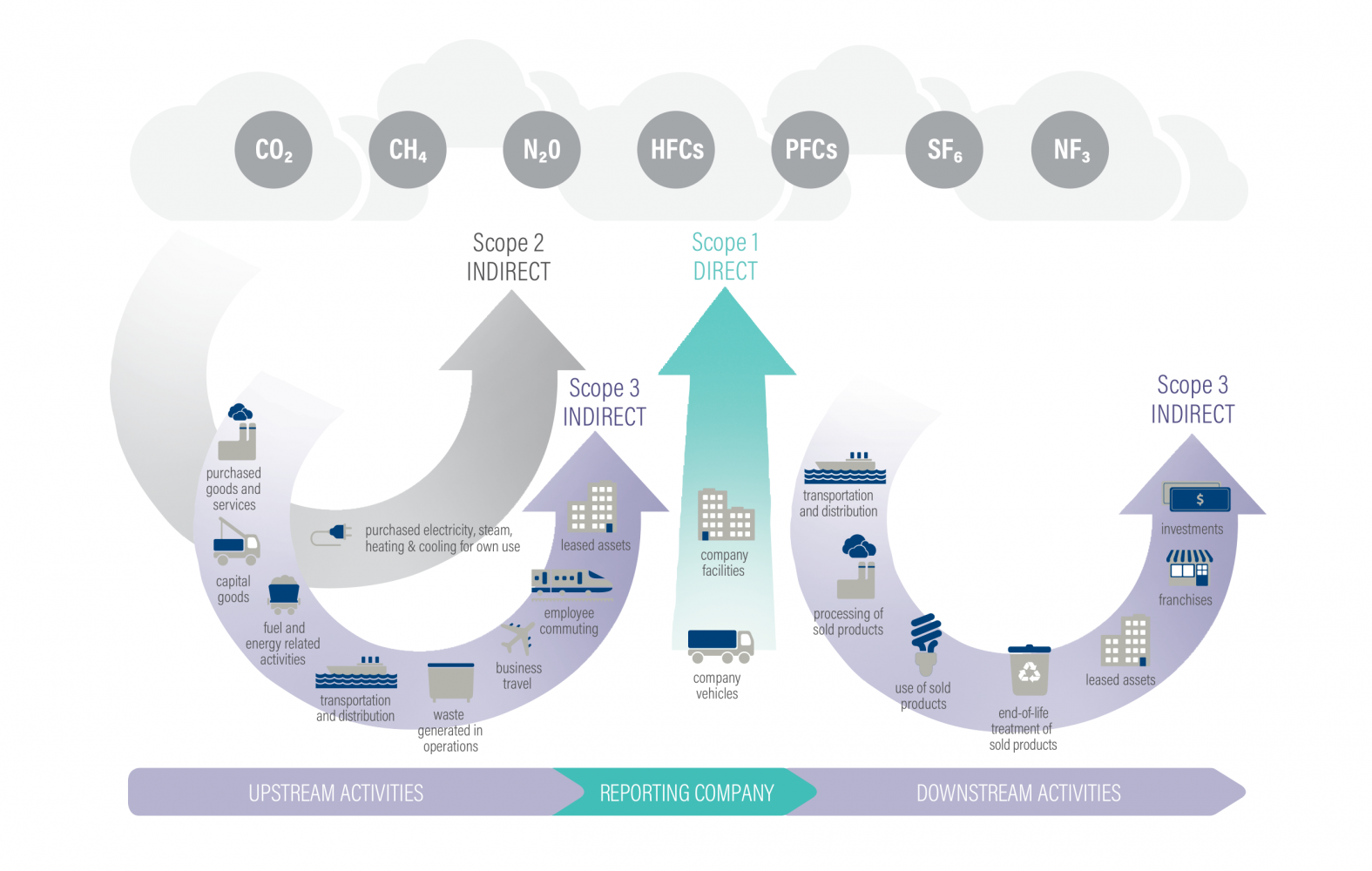
“Overview of GHG Protocol scopes and emissions across the value chain” by the World Resources Institute is licensed under CC by 4.0.
Green premium: The higher cost associated with low or zero emissions technologies when replacing high emissions technologies.
Hard-to-abate emissions: Emissions that are difficult to reduce short-term, usually from essential processes such as steel and concrete production or aviation.
Mature technologies: Ready, available, and tested technologies for deployment.
Microgrid: A group of interconnected energy resources that provides energy and storage locally, can be controlled independently and can be used within a wider grid or as a standalone source.
Mitigation: Processes and actions to reduce the effects of climate change, such as reducing sources of GHG emissions or removing GHGs from the atmosphere (e.g., carbon sinks).
Nature-based solutions: Actions based in nature to reduce and/or remove GHG emissions (e.g., carbon sequestration through tree planting) that conserve, restore and manage natural ecosystems while addressing social, economic and environmental challenges and providing benefits for human well-being and biodiversity.
Net zero emissions: The condition achieved when GHG emissions are balanced by removal of GHGs from the atmosphere.
Ocean acidification: The reduction of the ocean's pH level as a result of chemical changes, primarily from CO2 dissolving in the seawater.
Renewable fuels: Fuels derived or produced from renewable sources, such as organic waste, vegetable oils, or other biomass/feedstock.
Resilience: The capacity of a system and its components to cope with the anticipated and actual effects of a hazardous event or trend while maintaining essential functions and structures.
Safeguard Mechanism: A framework introduced in 2016 by the Australian Government to legislate limits (known as baselines) on the GHG emissions of Australia's largest industrial facilities. In alignment with Australia's target of net zero by 2050, these baselines will decline gradually and predictably. Find out more about the Safeguard Mechanism here.
Sustainable development: Growth and human development that meets the needs of the present without compromising the ability of future generations to meet their own needs, and balances economic, environmental and social concerns.
Value Chain: The lifecycle of a product, including all processes and materials involved, from conception to post-consumer disposal.
Venting and flaring: The disposal of gas that cannot be captured, used or otherwise handled, via the burning or realising of natural gas into the atmosphere.
References
Jenkins, K. (2025). Glossary for Decarbonisation Phrases & Terminology: Breaking Down the Jargon. Astutis. https://www.astutis.com/astutis-hub/blog/decarbonisation-sustainability-glossary
Carbon Market Watch. (2025). Carbon Credit. https://carbonmarketwatch.org/glossary/carbon-credit/
Climate Change Authority. (2025). Glossary. https://www.climatechangeauthority.gov.au/cca-glossary
IPCC. (2022). Annex II: Glossary. In Climate Change 2022: Impacts, Adaptation and Vulnerability. Contribution of Working Group II to the Sixth Assessment Report of the Intergovernmental Panel on Climate Change. (pp. 2897-2930). Cambridge University Press. https://www.ipcc.ch/report/ar6/wg2/downloads/report/IPCC_AR6_WGII_Annex-II.pdf
NSW Climate and Energy Action. (2026). Glossary. https://www.energy.nsw.gov.au/business-and-industry/programs-grants-and-schemes/primary-industries-productivity-and-abatement/glossary
World Resources Institute & World Business Council for Sustainable Development. (2004). The Greenhouse Gas Protocol: A Corporate Accounting and Reporting Standard (Revised Ed.). https://ghgprotocol.org/sites/default/files/standards/ghg-protocol-revised.pdf